
Finding free office space for startups in Korea can be one of the biggest advantages for early-stage founders.
Office rent in Seoul is expensive, and startup teams often need to spend money on product development, hiring, marketing, and operations long before they generate revenue. Between deposits, monthly rent, utilities, and coworking memberships, office costs can quickly consume valuable runway.
Fortunately, South Korea has a highly active startup ecosystem supported by government agencies, non-profit foundations, universities, and startup support organizations.
When I worked with startup support programs, I noticed that many successful startups did not begin with expensive private offices. Instead, they started in public startup hubs, incubators, accelerator spaces, and founder support centers before moving into larger offices.
For foreign founders, these programs can be especially valuable because many of them also provide visa support, incorporation assistance, mentoring, networking opportunities, and access to startup funding programs.
If you are looking for free office space for startups in Korea, this guide will help you understand where to apply and which startup spaces fit your business stage.
1. What Does Free Office Space for Startups in Korea Mean?
Before applying, it is important to understand what free office space actually means.
In Korea, free startup office space does not usually mean anyone can walk in and claim a private office.
Most programs provide one of the following
- Open coworking desks
- Startup incubator offices
- Government-backed startup offices
- Accelerator program offices
- Foreign founder support spaces
- Industry-specific startup hubs
Some locations are freely accessible, while others require an application, evaluation process, or startup selection program.
| Space Type | Main Feature |
|---|---|
| Open Coworking | Shared desks and open seating |
| Incubator Office | Private office for selected startups |
| Accelerator Space | Office linked to startup programs |
| Foreign Founder Center | Startup support for international founders |
| Industry Hub | Specialized support for fintech, AI, biotech, etc. |
2. Best Places to Get Free Office Space for Startups in Korea
Several government-backed and non-profit organizations provide startup office space throughout Korea.
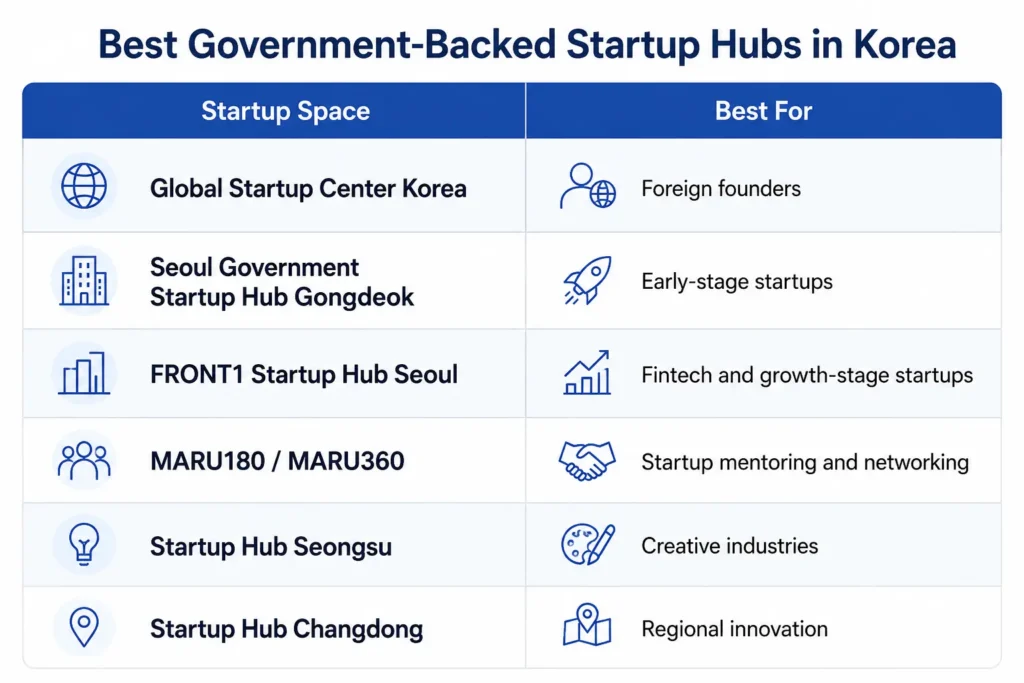
The following locations are among the most well-known startup hubs in Seoul.
Global Startup Center Korea
If you are an international founder, the Global Startup Center Korea should be one of the first programs you explore.
The center was created specifically to support foreign entrepreneurs entering the Korean startup ecosystem.
Services often include
- Free coworking space
- Meeting rooms
- Startup incubation support
- Visa guidance
- Incorporation assistance
- Networking events
- Translation and interpretation support
For founders unfamiliar with Korean regulations, the Global Startup Center can dramatically reduce the challenges of starting a business in Korea.
Best For
- Foreign founders
- International startups
- Tech startups entering Korea
- Entrepreneurs needing visa support
Official Website
Seoul Government Startup Hub Gongdeok
The Seoul Government Startup Hub Gongdeok is one of Korea’s most recognized public startup centers.
Operated by the Seoul Business Agency, the hub provides office space, mentoring, networking opportunities, and startup support programs.
Selected startups may receive office support while participating in incubation and acceleration programs.
Many startups use Gongdeok as their first professional office before moving into larger commercial locations.
Best For
- Early-stage startups
- Founders seeking public startup programs
- Startups preparing for investment
- Teams building local partnerships
Official Website
https://hubgongdeok.startup-plus.kr/en/about
FRONT1 Startup Hub Seoul
FRONT1 is one of the largest startup support centers in Korea.
Unlike a typical coworking space, FRONT1 focuses on connecting startups with investors, financial institutions, accelerators, and startup ecosystem partners.
Many founders consider FRONT1 a gateway into Korea’s startup investment network.
Best For
- Fintech startups
- Growth-stage startups
- Teams preparing for fundraising
- Companies seeking investment opportunities
Official Website
MARU180 and MARU360
MARU is operated by the Asan Nanum Foundation and is widely recognized as one of Korea’s leading startup communities.
Rather than functioning as a commercial coworking company, MARU operates as a non-profit startup platform.
Selected startups gain access to
- Startup office space
- Mentoring
- Educational programs
- Networking events
- Investor connections
The environment feels similar to a premium private coworking space while maintaining a strong startup-focused culture.
Best For
- Startup founders
- Teams seeking mentorship
- High-growth startups
- Startups preparing for fundraising
Official Website
Seoul Startup Hub Seongsu and Changdong
In addition to Gongdeok, Seoul also operates startup hubs in Seongsu and Changdong.
These hubs focus on regional innovation, creative industries, local entrepreneurship, and startup ecosystem development.
Depending on the program, startups may receive office space, mentoring, business support, and networking opportunities.
Best For
- Local startups
- Creative industries
- Urban innovation projects
- Early-stage companies
Official Website
3. Other Free Office Space Programs for Startups in Korea
Beyond the major startup hubs, there are additional programs worth exploring.
TIPS Town Korea
TIPS Town is closely connected to Korea’s famous TIPS startup ecosystem.
The space primarily supports startups that are connected to TIPS operators, accelerators, and government innovation programs.
While it is not a public coworking space, it can be highly valuable for deep-tech and R&D-focused startups.
Best For
- AI startups
- Deep-tech startups
- R&D companies
- TIPS-selected startups
Official Website
Seoul Campus Town Programs
Many universities in Seoul participate in Campus Town programs.
These programs often provide
- Startup offices
- Mentoring
- Educational programs
- Seed funding
- Community networking
Campus Town programs are especially useful for students and first-time founders.
Best For
- Student founders
- University startups
- Early-stage startup teams
- First-time entrepreneurs
Official Website
https://campustown.seoul.go.kr
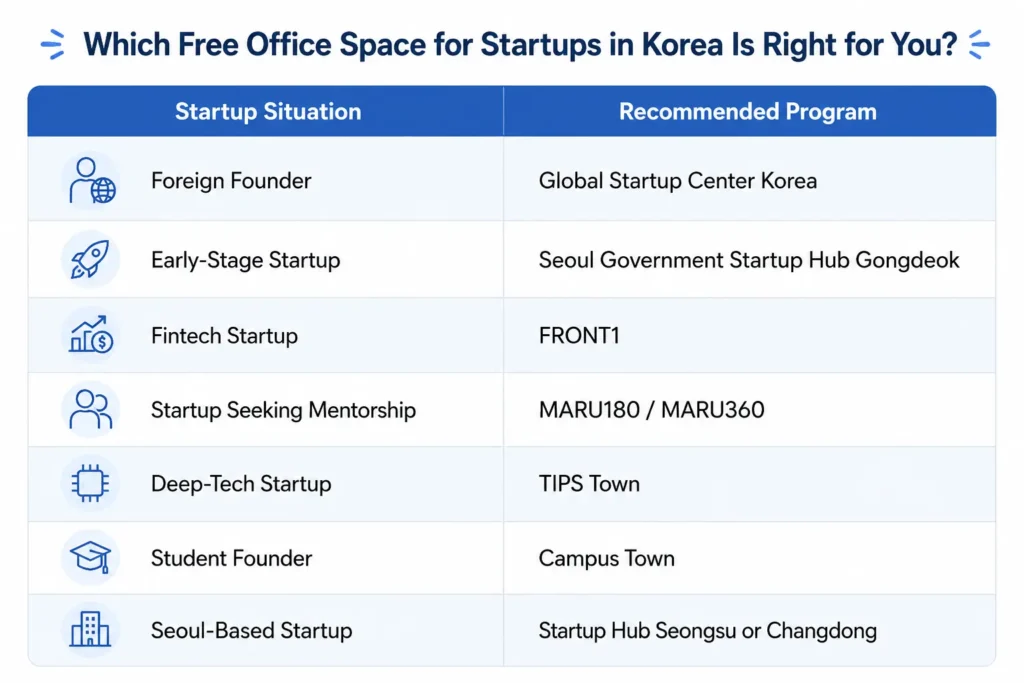
4. Which Free Office Space for Startups in Korea Is Right for You?
Not every startup should apply to the same program.
Choosing the right startup hub depends on your stage, industry, and business goals.
5. Application Checklist for Free Office Space for Startups in Korea
Most startup office programs require applications and evaluations.
Before applying, prepare the following documents.
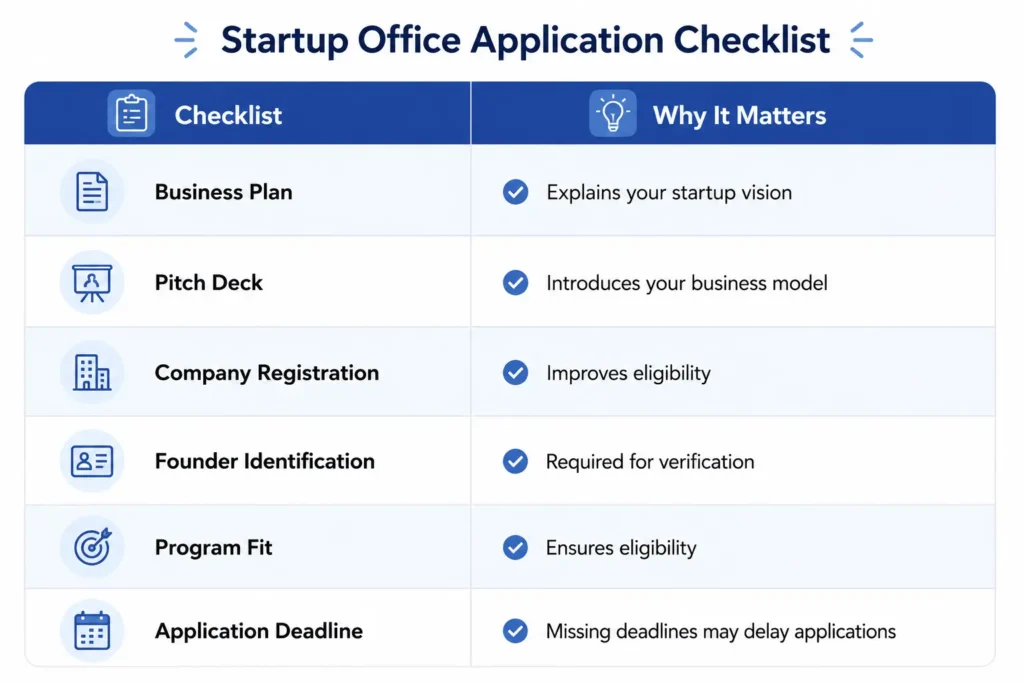
In many cases, having a clear business plan and realistic growth strategy is more important than having a finished product.
Startup support organizations often focus on the founder, team capability, and long-term potential.
6. Free Startup Hubs vs Paid Coworking Spaces
Many founders compare free office space for startups in Korea with commercial coworking spaces such as WeWork, FastFive, and SparkPlus.
Both options have advantages.
Free Startup Hubs
Advantages
- Reduced office costs
- Startup mentoring
- Access to government support programs
- Networking opportunities
- Startup ecosystem connections
Disadvantages
- Competitive selection process
- Limited recruitment periods
- Reporting requirements
- Fixed support periods
Paid Coworking Spaces
Advantages
- Immediate move-in
- Flexible contracts
- Premium facilities
- Professional business address
Disadvantages
- Monthly operating costs
- No startup support program benefits
7. Recommended Strategy for Foreign Founders
If you are entering Korea as a foreign entrepreneur, a practical strategy is
1) Start with Global Startup Center Korea
2) Build local business connections
3) Incorporate your company
4) Apply for Seoul Government Startup Hub programs
5) Explore mentoring and investor networks through MARU and FRONT1
6) Move into a private office only when your team grows
This approach allows founders to minimize expenses while building a strong foundation in Korea’s startup ecosystem.
Final Thoughts
Getting free office space for startups in Korea is absolutely possible through government-backed startup hubs, non-profit incubators, university programs, and founder support centers.
For most early-stage startups, Seoul Government Startup Hub, FRONT1, MARU, TIPS Town, and Campus Town programs are excellent starting points.
For international founders, Global Startup Center Korea remains one of the most valuable entry points into the Korean startup ecosystem.
Before applying, always check eligibility requirements, recruitment schedules, and official program details to find the startup space that best matches your business stage.
[Related Articles]